



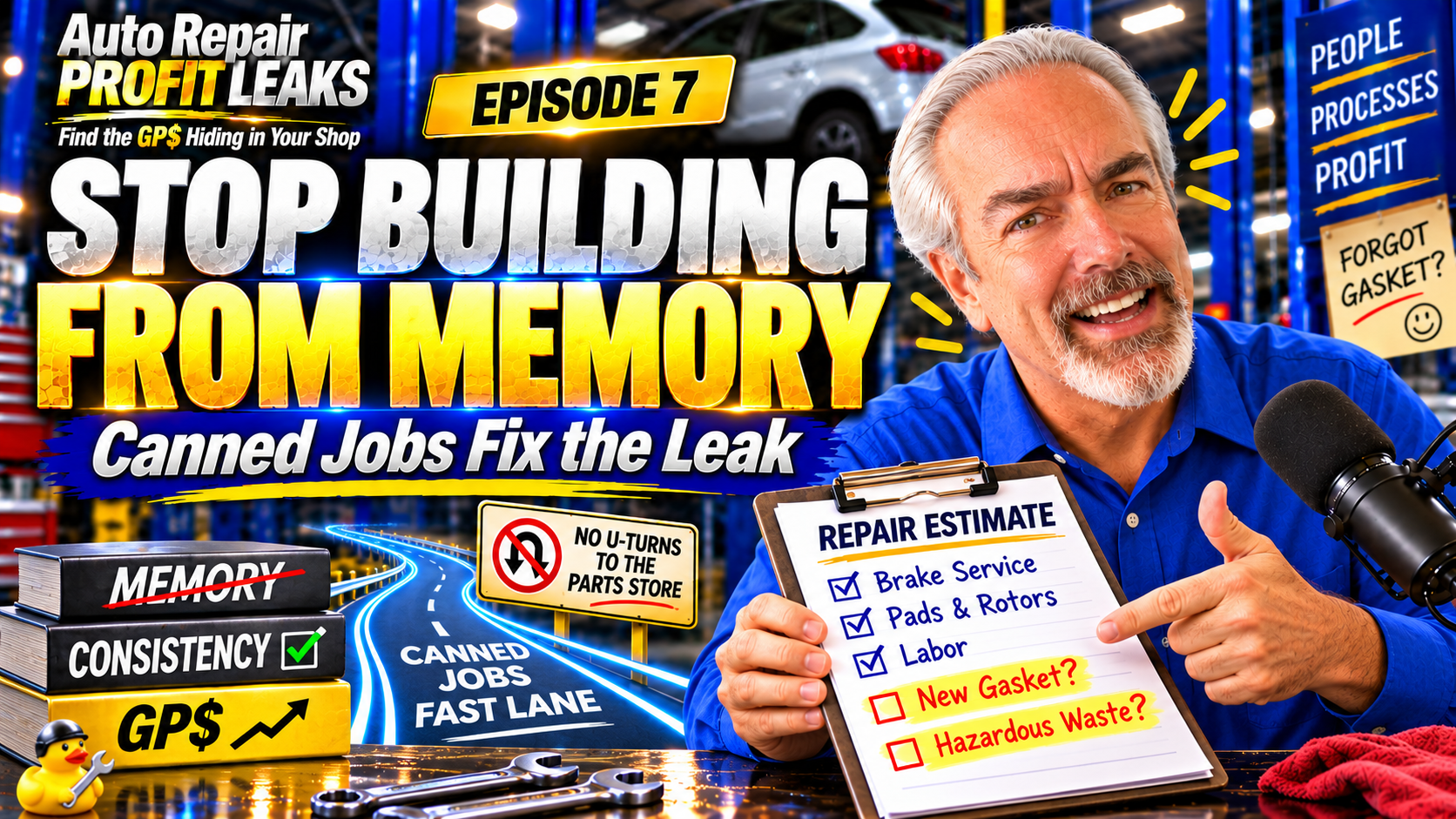
Stop Building Auto Repair Estimates From Memory: How Canned Service Packages Protect GP$
Stop Building Auto Repair Estimates From Memory
There is a dangerous phrase hiding inside a lot of auto repair shops:
“We just know what goes in that job.”
Do you?
Does every technician/specialist know?
Does every Service Advisor know?
Does the new person at the front counter know?
And does everyone remember it every single time?
That’s where the Profit Leak begins.
One of the biggest constraints inside an auto repair center is something every one of us deals with:
Memory.
We forget.
A gasket gets missed. A fluid doesn’t make it onto the estimate. An additional labor operation is overlooked. Programming isn’t included. The vehicle is already apart before someone realizes another component should have been ordered.
Now the Service Advisor is making another phone call.
The technician/specialist is waiting.
Parts has to scramble.
The promise time changes.
Another vehicle gets pushed back.
And what looked like one forgotten item begins affecting the throughput and GP$ of the entire shop.
Five Different Problems—or One?
During a recent Ask Dave Anything session, we started with five questions I hear from auto repair shops:
“We keep finding things that should have been included after the estimate was already approved. How do I fix this?”
“My advisors spend way too much time building estimates. How do I fix this?”
“Some of our jobs look profitable when we sell them, but the GP$ disappears by the time the job is finished. How do I fix this?”
“My newer advisors don’t know everything that should be included in a repair. How do I fix this?”
“My advisors can give customers a price, but struggle to explain the value of the repair. How do I fix this?”
At first, those sound like five separate problems.
I don’t believe they are.
They are often symptoms of the same breakdown:
The shop has not fully systemized how the job is built, validated, priced, and presented.
Your Service Advisor Shouldn't Have to Reinvent the Repair
Think about how many times your shop has performed the same common repairs.
Brake service.
Water pump.
Alternator.
Wheel bearing.
Cooling system repair.
Preventive Maintenance services.
Yet in many shops, every time one of those jobs comes through the door, somebody starts rebuilding the estimate again.
Find the labor.
Look up the parts.
Remember the fluids.
Think about the hardware.
Ask the technician what else is needed.
Check whether there is programming.
Try to remember the related services.
Then figure out how to explain all of it to the customer.
Why?
You already learned how to do that repair the last 50 times you performed it.
The knowledge should no longer live only inside somebody’s head.
It should live inside the system.
From Canned Job to Canned Service Package
Most shop management systems have some version of Canned Jobs.
But having a few parts and a labor operation saved under a button is only the beginning.
A true Canned Service Package should help capture what your TEAM has already learned about performing, pricing, and presenting that service correctly.
That can include:
The appropriate labor operations
Frequently required parts
Fluids and chemicals
Hardware and related components
Shop supplies or hazardous-material considerations
Programming or relearn procedures where applicable
Related Preventive Maintenance opportunities
Inspection or validation steps
Value words and reasoning
Customer-facing explanations
Internal reminders and triggers
Every time your TEAM discovers something that was missed, you have an opportunity.
Don’t simply fix that repair.
Fix the system so the next repair doesn’t have the same problem.
Build the Highway Once
I look at properly built Canned Service Packages like an estimating superhighway.
Without the system, your Service Advisor is driving through side streets every time an estimate needs to be built.
They’re searching.
Stopping.
Backing up.
Calling someone.
Looking something up.
Trying to remember where they went last time.
A well-built Canned Service Package puts them on the highway.
The job is already substantially built.
Now the advisor can:
Click. Validate. Present. Go.
That doesn’t mean blindly selling whatever pops onto a screen.
The Service Advisor still has to validate the specific vehicle, parts, labor, conditions, and customer needs.
But they are starting from a proven process instead of a blank screen.
That’s a huge difference.
Stop Making Your Advisors Walking Encyclopedias
We sometimes put an unreasonable expectation on Service Advisors.
We hire somebody and then expect them to memorize years—or decades—of automotive knowledge before they can become successful at the front counter.
Why?
A strong business system should carry part of that knowledge for them.
The advisor’s highest-value responsibility isn’t memorizing whether a particular repair requires an additional seal, fluid, fastener, or procedure.
Their value is in the customer relationship.
Listening.
Asking questions.
Explaining findings.
Communicating VALUE.
Building trust.
Helping customers make good decisions about their vehicles.
If your advisor spends most of the day hunting through catalogs and reconstructing jobs your shop has already done hundreds of times, you may be using an expensive relationship professional as an estimate-building machine.
GP$ Can Leak Before the Job Ever Reaches the Bay
A job can look profitable when it is sold and still lose GP$ during production.
Why?
Because something wasn’t included.
The labor was underestimated.
A part was forgotten.
The overlap wasn’t handled correctly.
A necessary operation was given away.
The Service Advisor discounted because they became uncomfortable with the total.
The technician discovers additional required steps after the repair begins.
That’s why profitability has to be built into the job before it is presented.
When the job is structured correctly, the Service Advisor has something much stronger to stand behind.
They aren't inventing the price.
They aren't guessing at the value.
They are presenting a system the shop has already established.
Value Words Should Be Part of the System
There’s another major benefit.
A Service Advisor may know the price of a repair without being able to communicate why the customer should spend the money.
Those are two completely different skills.
“Your total is $1,486.”
That’s a price.
It is not value.
A strong Canned Service Package can help carry the value words and reasoning behind the operation.
What does this component do?
Why is the service needed?
What are we doing during the repair?
What related items are being checked?
What problem are we helping the customer prevent?
What benefit does the customer receive?
When this information is built into the process, you don’t have to hope every Service Advisor remembers the perfect explanation every time.
Again:
Take critical knowledge out of memory and put it into the system.
Your Systems Should Get Smarter Every Month
Canned Service Packages should never be viewed as something you create once and forget about.
They should improve.
Review your repair orders.
Ask:
What did we miss?
Where did we lose time?
What part did we have to order after the vehicle was already apart?
Where did the technician lose efficiency?
Where did the advisor struggle during the presentation?
Where did GP$ disappear?
What Preventive Maintenance service should have been presented at the same time?
Then take what you learned and put it back into the package.
That’s how your operating system becomes smarter.
Your TEAM stops repeating yesterday’s mistakes.
Manage the System. Lead the People.
This is where owners and managers sometimes get it backwards.
We try to manage people harder when the process itself is weak.
A Service Advisor misses something, so we tell them:
“Pay more attention.”
“Remember that next time.”
“Slow down.”
“Check your work.”
Those conversations may have a place.
But ask another question:
Why did the business require that person to remember it in the first place?
If something is important enough that it needs to happen repeatedly, it should probably be supported by a repeatable process.
Build and manage the systems.
Then lead the people who use them.
That is very different from expecting talented employees to compensate for broken processes.
What Could This Change in Your Shop?
Imagine your Service Advisors spending less time rebuilding estimates.
Imagine newer advisors learning your preferred way of doing business faster.
Imagine fewer missed parts.
Fewer interruptions.
Fewer technician delays.
More consistent pricing.
More consistent customer presentations.
Better Preventive Maintenance conversations.
Stronger technician efficiency.
Better shop throughput.
And more GP$ staying inside the job where it belongs.
That is the real opportunity behind Canned Service Packages.
It isn’t about creating a shortcut.
It’s about creating a business system.
A system that captures what your shop already knows and makes that knowledge repeatable.
Because if your shop has to remember how to build the job every single time, you don’t have an estimating process.
You have a Profit Leak.
Watch the Full Ask Dave Anything Episode
In this episode of Auto Repair Profit Leaks | Ask Dave Anything, Mike Cooper and I dig deeper into Canned Jobs, Canned Service Packages, estimating, Service Advisor development, shop throughput, value communication, and the GP$ that can disappear when your systems depend too heavily on memory.
Watch the full episode and then take a look at your own point-of-sale system.
Pick five of your most common services.
Open the Canned Jobs.
And ask yourself:
“If I hired a new Service Advisor tomorrow, would this package help them build and present this job the way I want it done?”
If the answer is no, you just found a place to start.
Find More GP$ Hiding in Your Shop
Join the Auto Repair Profit Leak Challenge | Find the GP$ Hiding in Your Shop Facebook community:
https://www.facebook.com/groups/autorepairprofitleakchallenge
For CompuTrek training, coaching, and Canned Service Package resources, visit: