


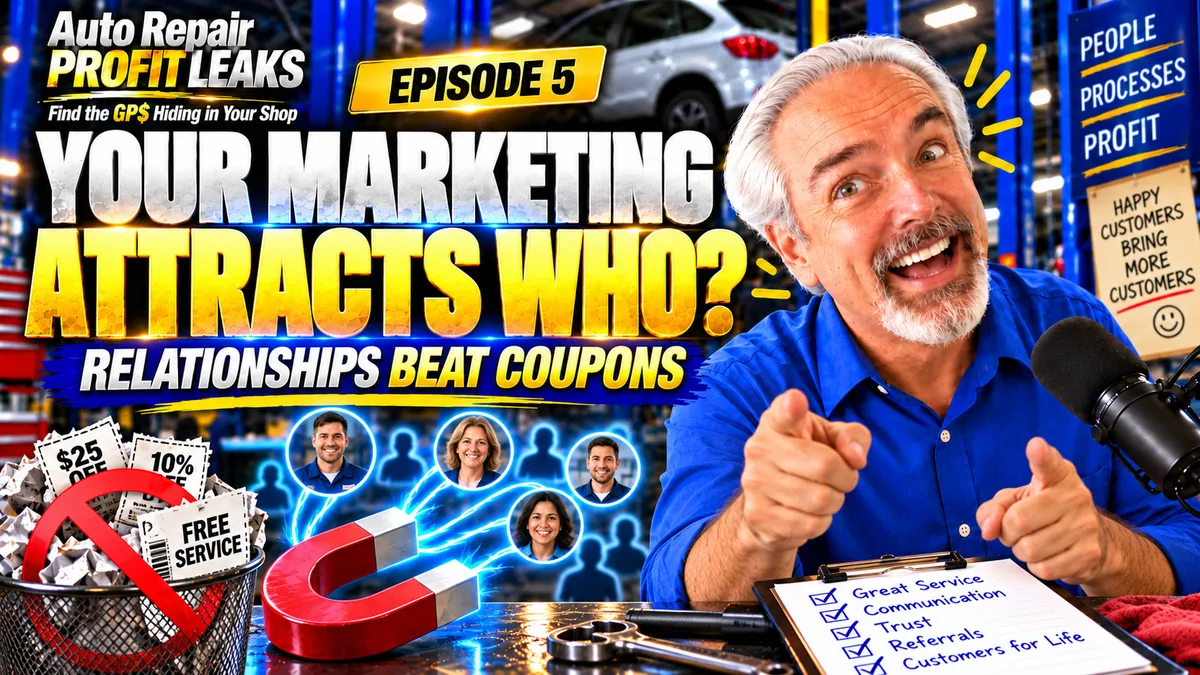
Auto Repair Marketing Profit Leaks: Are You Attracting the Wrong Customers?
Most shops ask a familiar marketing question:
“How do we get more customers?”
That may be the wrong question.
A better one is:
Is your marketing bringing you customers—or just more work without GP$?
That was one of the hard questions we explored in this episode of Auto Repair Profit Leaks.
Because your phone can ring.
Your schedule can fill up.
Your car count can increase.
And your marketing can still be leaking profit.
Getting Busy and Getting Profitable Are Not the Same Thing
One of the easiest ways to generate activity is to advertise price.
Cheap oil change.
Discounted service.
Coupon.
Special.
And yes—those offers can work.
They can make the phone ring and put vehicles in your bays.
But as Dave points out in this episode:
Discounts can get you busy without making you profitable.
The question is not simply whether someone responded to the marketing.
The question is:
Who did your marketing attract?
If the entire reason that customer chose your shop was the lowest advertised price, what happens when someone else advertises a lower one?
You haven't necessarily built a customer relationship.
You may have simply rented a transaction.
A Discount and an Incentive Are Not the Same Thing
This distinction matters.
A discount is often designed around reducing price to create a transaction.
An incentive can be designed strategically to encourage a behavior while maintaining the profitability of the service.
That means the shop needs to understand the GP$ impact before the offer ever reaches the marketplace.
Marketing should not force your Service Advisor to spend the entire customer conversation overcoming the price expectation the advertisement created.
If your advertising says:
“Choose us because we're cheap,”
your front counter now has to convince that same customer:
“Choose us because we're valuable.”
Those messages fight each other.
Your Service Advisors Are Part of Your Marketing
Marketing doesn't end when somebody clicks the ad.
It doesn't end when they visit the website.
And it certainly doesn't end when the phone rings.
The experience continues at the front counter.
If your marketing communicates trust, expertise and long-term vehicle care—but the customer walks into the shop and gets:
“Give me your keys. We'll call you.”
—you've created a communication gap.
The marketing promised a relationship.
The experience delivered a transaction.
That gap can show up in:
Lower hours per repair order
Lower average repair orders
Reduced customer retention
Weaker referrals
More price objections
Lost GP$
This is why we believe your Service Advisors are your front-counter marketers.
They are the human continuation of the message your marketing started.
Stop Chasing New Customers While Existing Ones Disappear
The second hard question from this episode was:
Why are you spending money finding new customers while your existing customers are disappearing?
Every shop experiences customer attrition.
People move.
Vehicles get sold.
Life circumstances change.
But if customers who should be staying are leaving, more advertising may not fix the problem.
It may simply pour more customers into a leaking bucket.
Look at your customer retention.
Look at your attrition.
Then ask why.
Are customers leaving because of your market?
Or are they leaving because of the experience?
Relationships Create Better Marketing
One of Dave's major points throughout the episode is that marketing should create movement toward a relationship.
That relationship becomes especially important when something goes wrong.
Mike shares an example of a shop that made a significant mistake on a customer's vehicle and took full responsibility.
The trust had been built so deeply that the customer left the shop a five-star review before even receiving the repaired vehicle back.
That's the power of trust.
Perfect execution is important.
But strong relationships give customers context for what happens when perfection doesn't happen.
Your Best New Customer May Be a Referral
There's another major advantage to relationship-driven marketing:
Referrals arrive differently.
A referred customer isn't starting from zero trust.
Someone they already trust has transferred some of that credibility to you.
Mike and Dave discuss why referred customers can spend more and enter the relationship with a different mindset than someone who simply responded to a price advertisement.
Dave shares the benchmark he used in his own shop: he wanted a significant majority of new customers coming from word-of-mouth marketing.
Whether your specific target matches his or not, the question is valuable:
What percentage of your new customers come because an existing customer couldn't stop talking about you?
That is a powerful marketing KPI.
Local Marketing Still Matters
Digital marketing is important.
Websites matter.
SEO matters.
Search advertising matters.
But local businesses have sometimes abandoned one of their most powerful marketing advantages:
Relationships with other local businesses.
What businesses already serve the same people you want to serve?
Detail shops?
Body shops?
Local restaurants?
Professional services?
Businesses with employees who fit your ideal customer profile?
Instead of only competing for clicks, look for opportunities to build local relationships and referral ecosystems.
Know More Than Your “Ideal Customer”
Your ideal customer isn't simply:
Age
Income
ZIP code
Vehicle
Look deeper.
What do they value?
How do they communicate?
What vehicles do your most profitable customers drive?
How old are those vehicles?
What stage of the vehicle lifecycle creates the strongest opportunity for your shop?
What other businesses do those customers use?
When you understand those answers, your marketing becomes more precise.
You're no longer marketing to “everyone who owns a car.”
You're communicating with the people your shop is uniquely equipped to serve.
Stop Saying You're “Cheaper Than the Dealer”
One of the examples Dave discusses is a shop whose marketing essentially said:
“We're cheaper than the dealer, but we're just as good.”
Think about what that communicates.
You just positioned the dealership above you.
Now your Service Advisor has to overcome the very belief your marketing created.
Independent repair shops should understand the value they bring.
Dealerships spend much of their time working with vehicles in the earliest years of their lifecycle.
Independent shops often develop tremendous experience with vehicles as they age, accumulate mileage and become more diagnostically complex.
That expertise is valuable.
Market it like it is.
The Question to Ask About Your Marketing Today
Pull up your website.
Look at your latest mailer.
Read your emails.
Look at the ad you're currently running.
Then ask:
What's the biggest message?
Is it the dollar sign?
Or is it the relationship?
Does your marketing tell people:
“We're cheap.”
Or does it communicate:
“We understand you, we understand your vehicle, and we're committed to helping you get the greatest life and value from it.”
Those attract very different customers.
And they can produce very different GP$.
Find the Profit Leaks You Can't See
Marketing is only one area where GP$ can quietly disappear.
Sometimes the problem is the front counter.
Sometimes it's production.
Sometimes it's labor strategy.
Sometimes it's owner thinking.
And sometimes it isn't one giant leak at all.
It may be a series of 2% leaks occurring throughout the business.
That's why the goal isn't simply finding another marketing tactic.
It's seeing the entire business differently.
If you're ready to identify the GP$ hiding inside your shop, visit CompuTrekSystems.com and explore the Auto Repair Profit Leak Challenge and Profit Leak Bootcamp.
Because more car count isn't necessarily the answer.
Better customers. Better relationships. Better retention. Better decisions. More GP$.