
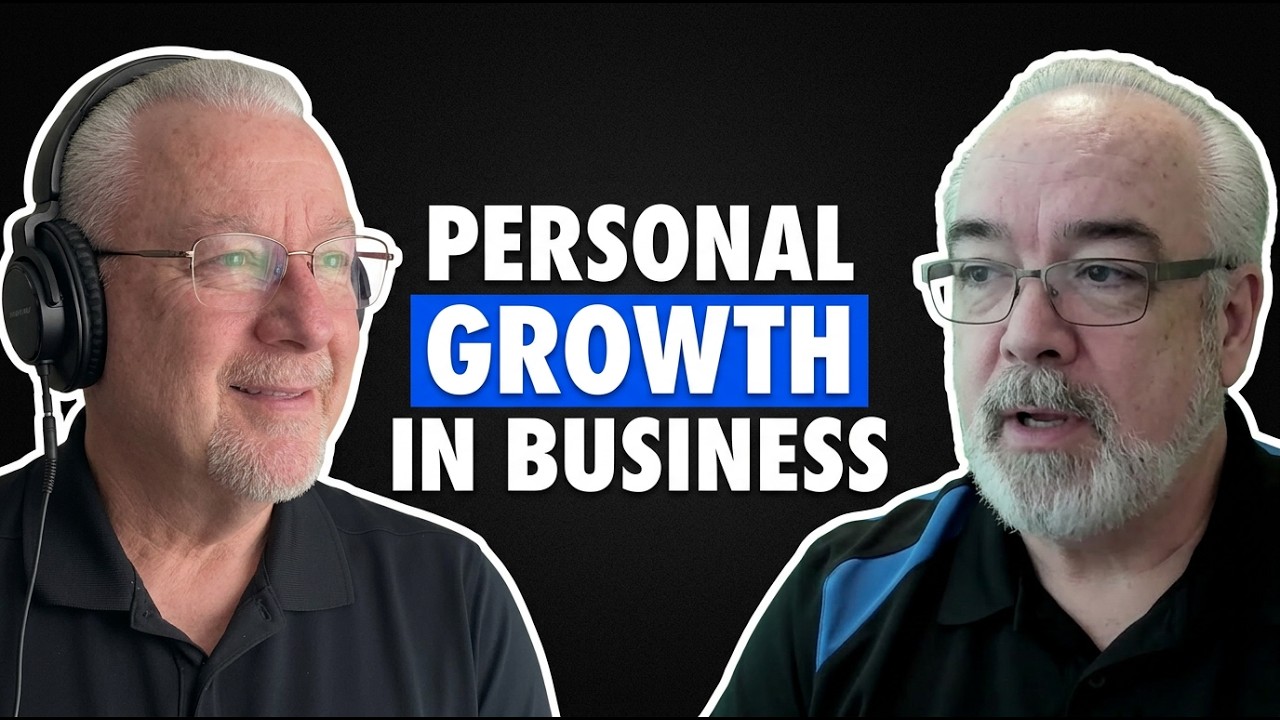
To Reach Level Ten You Have To Dig Deep.
Apple podcast: https://podcasts.apple.com/us/podcast/ep21-to-rise-to-a-level-10-you-must-dig-deep-with/id1779156602?i=1000756392302
To Reach Level Ten You Have To Dig Deep.
Personal Development, Purpose, and the Future of Shop Leadership
A conversation between Greg Buckley and Dave Schedin
Why personal development matters in business
Dave Schedin’s journey: from automotive to transformation
The difference between behavior modification and transformation
Knowing yourself before you can lead others
The technician shortage — and the bigger issue behind it
Service advisors are carrying too much
The Infinite Game: building something bigger than yourself
Leadership, age, fear, and the changing self
How do you bring personal development to your team?
Final takeaway: You cannot build a great business while neglecting the person building it
Personal Development, Purpose, and the Future of Shop Leadership
A conversation between Greg Buckley and Dave Schedin
On this episode of Shop Soup Podcast, Greg Buckley sat down with Dave Schedin of Computrek Systems to talk about something that does not get enough attention in the automotive industry: personal development.
For years, shop owners have focused on the visible side of business growth — car count, gross profit, technician recruiting, service advisor performance, and operational systems. But as Greg and Dave explored in this conversation, the deeper issue is often not tactical at all. It is personal.
Who are you as a leader?
What do you want your business to become?
What is the mission behind the work?
According to Dave, those questions are not optional. They are foundational.
Why personal development matters in business
Greg opened the conversation by highlighting a growing trend in the industry: more coaches and more business leaders are beginning to teach personal development alongside operations and financial performance.
That shift matters.
As both Greg and Dave noted, you cannot build a meaningful business without understanding yourself first. If you do not know your own goals, your values, your mission, or your long-term vision, the business can easily become reactive instead of intentional.
As Greg put it, the systems, processes, and market knowledge can all be taught. But if the owner lacks clarity about where they want to go and why they are going there, the business will always feel like a struggle.
Dave agreed — and took it further.
He explained that many shop owners can answer tactical questions quickly, but struggle when asked a simple one:
What do you actually want your business to look like?
That is where the real work begins.
Dave Schedin’s journey: from automotive to transformation
Dave shared that he originally thought he would become a psychologist. He became fascinated early in life by how the mind works, how emotions shape behavior, and how people think.
Instead, he entered the automotive world, eventually building and selling his own shop. Over time, his path led him into coaching, where he discovered that the biggest breakthroughs in business were often not mechanical or financial — they were internal.
He recalled a turning point in his own career when a coach introduced the idea of profitability not just as a financial goal, but as an outcome of service from the heart. That perspective stayed with him.
Later, after major personal upheaval in his own life, Dave invested deeply in personal development. He said that while his coaching methods did not dramatically change, he changed — and that change affected everything.
Before that work, his average client was gaining significant gross profit improvement. After his personal growth journey, that impact increased dramatically.
His conclusion was simple: when he got out of his own way, he became a better leader and a better coach.
The difference between behavior modification and transformation
One of the strongest ideas Dave shared was this:
Many coaches teach behavior modification. Few lead transformation.
In practical terms, that means a shop can be told what to do — raise labor rates, improve inspections, increase average repair order, refine advisor scripting — but unless the owner’s thinking changes, the results often do not stick.
The moment outside pressure disappears, the business tends to drift back into old patterns.
Dave believes lasting change only happens when the owner’s mindset changes first.
Fear, scarcity, insecurity, ego, people-pleasing, overwork, and unresolved personal patterns all show up in business. They affect hiring, pricing, communication, accountability, team development, and long-term vision.
That is why personal development is not a side topic. It is leadership work.
Knowing yourself before you can lead others
Greg brought the discussion back to a point many owners will recognize: you have to know yourself before you can really know what you want your business to become.
He talked about vision, mission, discipline, and the tendency many entrepreneurs have to fight against structure while still wanting meaningful results. There is often a pull between freedom and focus, between joy and discipline.
Dave responded with one of the most important distinctions in the conversation: discipline is not just about productivity. It is also about beingness.
In other words, a mature leader learns how to bring discipline, joy, rest, focus, and self-awareness together. Taking a break, stepping into enjoyment, or embracing life outside the shop does not mean a person has become undisciplined. It may simply mean they have learned balance.
That balance is what keeps the business from becoming a prison.
The “level 7” problem
Throughout the conversation, Dave used a compelling metaphor: many owners settle at a level 7, mistaking it for a level 10.
They are doing better than the shops around them. They are profitable enough. The team is functioning. The business is stable. And compared to the chaos many others live in, it feels successful.
But “better than average” is not always the same as true fulfillment or true excellence.
Dave said that one of the biggest challenges in coaching is helping people recognize where they have settled — not in a shameful way, but in an honest one.
That settling affects everything:
how they pay their people,
how they define excellence,
how they train,
how they build culture,
and how much of their real purpose they are willing to pursue.
The point is not that every owner should build a massive empire. The point is that every owner should be honest about what they truly want.
For one person, one high-performing shop may be the dream.
For another, it may be twenty locations.
For someone else, it may be a business that funds ministry, family, travel, or community impact.
The issue is not size. The issue is clarity.
The technician shortage — and the bigger issue behind it
Greg and Dave also touched on the technician shortage, but not in the usual way.
Greg questioned whether there is really a shortage in the absolute sense, or whether the industry needs to take more responsibility for developing talent. He pointed to his own experience bringing in interns, training from the ground up, and investing in people who did not come from traditional backgrounds.
Dave agreed that the bigger issue is not just labor supply. It is mindset.
He argued that the industry has often operated from scarcity:
scarcity in pay,
scarcity in training,
scarcity in leadership,
scarcity in vision,
and scarcity in how it presents itself to the next generation.
That scarcity has consequences.
If the industry wants high-performing technicians and advisors, it needs to create environments that look attractive, stable, developmental, and meaningful. It needs to pay accordingly, train seriously, and think in terms of abundance rather than bare-minimum retention.
Service advisors are carrying too much
Another strong section of the conversation focused on service advisors.
Greg asked whether shops are overloading advisors with too many responsibilities: selling, follow-up, scheduling, parts coordination, communication, dispatching, and more.
Dave’s answer was clear: yes, many advisors are being asked to do the work of multiple people.
He noted that in larger organizations or dealerships, many of these responsibilities are distributed across several roles. In independent shops, they are often pushed onto one person.
That creates overload, inconsistency, and burnout.
His solution was to think differently about support roles. Whether that means a parts specialist, an advisor assistant, or stronger systems and process triggers, the goal should be to free the advisor to focus on what matters most: communication, trust, and relationship with the customer.
The Infinite Game: building something bigger than yourself
One of the most memorable themes of the conversation was The Infinite Game, inspired by Simon Sinek’s book of the same name.
Dave and Greg both returned to the idea that the goal of business is not simply to “win” in the short term. It is to build something enduring.
Greg framed that in terms of legacy. As a second-generation operator, he talked about wanting to see the business reach 100 years, even if he is not personally there to witness it.
Dave connected that vision to purpose and calling. A calling may change over time — father, owner, mentor, technician, coach — but purpose is the deeper thread that gives all those roles meaning.
That is what makes the work sustainable.
That is what gives business its soul.
Leadership, age, fear, and the changing self
Greg also brought a deeply personal angle into the conversation by talking about age, change, and health.
He reflected on how major life events can shake a person’s confidence and identity, especially for leaders who are used to being strong, capable, and always in control. His comments about facing health challenges and suddenly feeling vulnerable added emotional weight to the episode.
Dave met that moment with honesty of his own.
He talked about self-awareness, emotional patterns, childhood wounds, autopilot behaviors, and the importance of learning to respond rather than simply react. He described personal growth not as a one-time achievement, but as a lifelong discipline.
Some days feel energized.
Some days feel heavy.
And often, the difficult days reveal the most.
That kind of honesty is exactly why more business leaders are beginning to see personal development as essential, not optional.
How do you bring personal development to your team?
Toward the end of the conversation, Greg asked a practical question:
How do you bring these principles to employees, not just owners?
Dave explained that it starts with hiring, onboarding, and culture. If a shop truly values growth, training, accountability, and self-awareness, those things need to be built into the way people are introduced to the business.
He emphasized the importance of hiring not only for skill, but also for character traits and behavioral fit. He also recommended leadership-focused resources that help teams understand themselves and how they relate to others.
Among the books he mentioned:
Leadership and Self-Deception by The Arbinger Institute
The Anatomy of Peace by The Arbinger Institute
The Infinite Game by Simon Sinek
The E-Myth Revisited by Michael Gerber
These are not just business books. They are leadership books. And leadership, as Dave made clear, begins internally.
Final takeaway: You cannot build a great business while neglecting the person building it
This conversation between Greg Buckley and Dave Schedin was about far more than shop performance.
It was about identity.
Purpose.
Discipline.
Joy.
Legacy.
And the courage to do inner work that most people avoid.
The automotive industry is changing. Its tools are changing. Its business models are changing. Its training methods are changing.
And now, perhaps most importantly, its definition of leadership is changing too.
Not every breakthrough comes from a better process.
Sometimes it comes from a better understanding of yourself.